
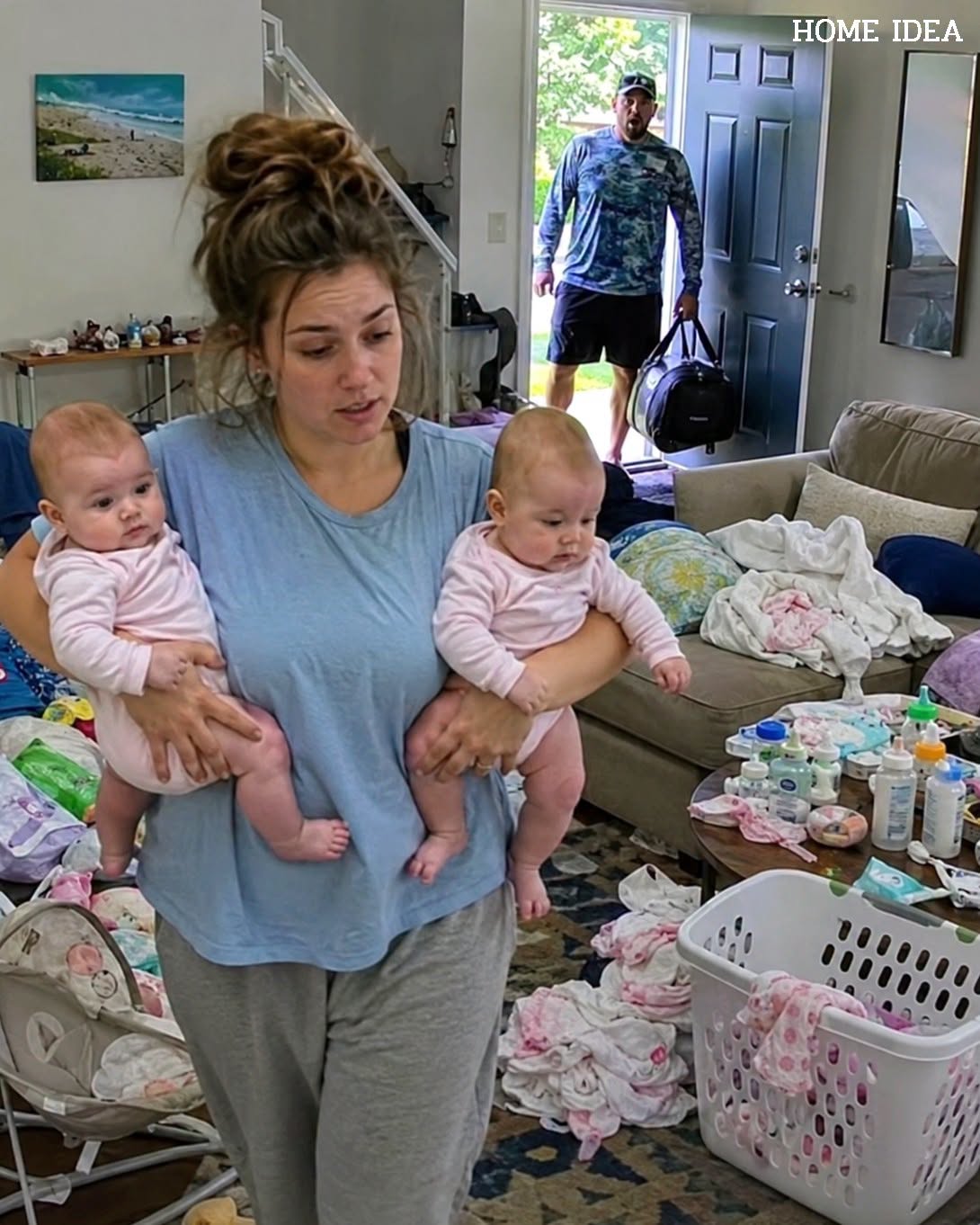
The Four-Day Absence: How a Husband’s ‘Luxury Escape’ Collapsed at His Own Front Door
When a husband tapped emergency savings to fund a fishing getaway—leaving his exhausted wife alone with six-month-old twins—he assumed he was stepping away from domestic stress. He returned to a house full of witnesses, an empty bank record on the table, and his packed bags waiting by the door.
The Boiling Point
For six grueling months, Amy’s world was calibrated by the relentless rhythm of newborn twins: two-hour feeding intervals, endless mountains of laundry, and a state of sleep deprivation so deep it blurred the edges of every waking hour. Lila and Ivy were the dream she and her husband, Brandon, had spent years praying for. But when the reality of twin parenthood arrived, the shared dream quickly morphed into a solo endurance test.
Amy never complained. She carried the heavy lift of the midnight shifts, the quiet desperation of trying to soothe two wailing infants simultaneously, and the mental load of keeping a household running on zero reserves.
Then came the evening that broke the dam.
Sinking under the weight of sheer physical fatigue, Amy asked Brandon a simple favor: Could he wash the four cloudy baby bottles sitting in the sink?
Brandon glanced around the messy kitchen, sighed deeply, and aired his own grievances. He was exhausted, he explained, from returning home every evening to crying babies, unwashed bottles, and a wife who looked perpetually stressed. Before Amy could process the words, he revealed his solution: he had already booked a four-day luxury fishing trip with his friends. He simply needed a break.
When Amy asked how he expected her to survive four days completely unassisted with two infants, Brandon didn’t bother looking up from his duffel bag.
He shrugged and delivered a line that severed the remaining foundation of their partnership:
“You wanted to be a mother, so act like one.”
He zipped his bag and walked out the door.
The Four-Day Escape & Financial Betrayal
For ninety-six uninterrupted hours, Amy was left in survival mode. She subsisted on cold coffee and half-eaten granola bars, keeping Lila and Ivy safe while running on pure adrenaline.
But as the days ticked by, the true scope of Brandon’s departure came into focus.
Realizing Amy was isolated and struggling, her sister, Summer, and her mother-in-law, Dawn, rushed over to assist. It was during this period that Dawn made a disturbing discovery: Brandon hadn’t just taken a quick trip—he had drained $2,000 from their shared emergency savings account to fund cabin rentals, boat fees, and fuel. It was money Brandon had previously claimed was unavailable for short-term childcare support.
To make matters worse, Brandon began posting updates online, boasting about the serene waters, the quiet mornings, and the much-needed relaxation he was finally enjoying.
When Dawn innocently commented on one of his celebratory social media posts, asking who was covering the home front with the twins, Amy decided she was done protecting her husband’s polished public image. She replied truthfully to the comment, detailing the reality of the situation.
Within hours, the post went viral among their circle. The facade crumbled. Brandon’s pristine getaway turned into a public exposure of neglect, leaving his friends stunned and his social media feed flooded with backfire.
The Sunday Return
When Sunday afternoon arrived, Brandon unlocked the front door carrying his fishing gear, expecting to slip back into his normal routine.
Instead, he froze dead in the doorway.
The scene inside was laid out with surgical precision:
The Witness Lineup: In the living room sat his mother, Dawn, holding Ivy, alongside Amy’s sister, Summer, bottle-feeding Lila.
The Evidence Table: Laid neatly on the kitchen table were printed hard copies—a screenshot of his tone-deaf vacation post, four days of meticulous feeding and diaper logs, and the bank statement highlighting the $2,000 withdrawal from their emergency fund.
The Departure: Right by the bottom of the stairs sat his own packed duffel bag.
Brandon’s relaxed demeanor evaporated instantly. He looked toward his mother for support, but Dawn merely adjusted her granddaughter’s blanket and maintained absolute silence.
The Confrontation
“What is this, Amy?” Brandon stammered, his face flushing dark red. “You humiliated me online.”
Amy stood her ground, her voice measured and quiet.
“I didn’t make you look like anything, Brandon. I just stopped hiding what you did.”
When Brandon attempted to brush the situation off as a simple four-day misunderstanding, Amy refused to engage in the old dynamic. She slid a written document across the table detailing mandatory conditions moving forward:
Immediate entry into professional marital counseling.
A strict, equitable daily parenting schedule.
Full repayment of the stolen $2,000 emergency fund back into the shared account.
An absolute end to gaslighting her regarding domestic labor.
Stunned by the terms, Brandon looked around the quiet room. “You’re throwing me out?”
Amy picked up his duffel bag, walked over, and placed the strap firmly into his hand.
“You packed because you thought you could step away whenever this family became difficult. Now carry it while you decide whether being a father is something you actually want to practice at home.”
Without an argument left to make, Brandon turned around and walked back out to his car.
The Reality Check
The separation forced a shift that words alone had failed to achieve. Weeks later, during his first scheduled solo custody period, Brandon spent a full, uninterrupted 24 hours responsible for both Lila and Ivy by himself.
When he returned the girls, the bravado was entirely gone. Exhausted, humbled, and visibly worn down, he looked at Amy and offered a quiet, raw admission:
“I didn’t know it was this hard.”
Amy accepted the return of her daughters, handing him the diaper bag without needing to say a word. For six months, she had minimized her own suffering to maintain the illusion of a smooth domestic life. But as she held Lila close against her chest, she knew the narrative had permanently changed—not just for her marriage, but for the lesson her daughters would grow up to learn: real love never requires a mother to erase herself.
Part 2: The Final Verdict
The silence that followed Brandon’s quiet admission hung heavy in the foyer, broken only by the rhythmic, soft cooing of Lila resting against Amy’s shoulder. For months, Brandon had worn his ignorance like armor, hiding behind the comfortable lie that domestic labor was simply a woman’s natural instinct rather than exhausting, around-the-clock labor. But one solitary day alone with the relentless demands of infant twins had shattered his illusion.
“I didn’t know,” he repeated, his voice cracking as he stared at his own trembling hands. He looked hollowed out—dark circles bruised the skin beneath his eyes, his shirt was stained with formula, and his shoulders slumped under the weight of sheer physical defeat. “Amy… I swear, I truly didn’t realize what you were carrying every single day.”
Amy looked at the man she had loved for nearly a decade. Once, those words might have softened her. She might have rushed to comfort him, to minimize her own exhaustion just to lighten his guilt. But the woman who had survived four days of complete abandonment, who had watched her husband drain their hard-earned emergency savings for a luxury vacation while she drowned in sleep deprivation, was no longer willing to play the martyr.
“You didn’t know because you chose not to see,” Amy said, her voice steady and devoid of malice, yet cold as iron. “I told you I was sinking, Brandon. I asked for help with four simple bottles, and you told me to ‘act like a mother.’ You didn’t lack information. You lacked empathy.”
Brandon swallowed hard, unable to meet her gaze. “I’m back in therapy, like you asked. I paid back the $2,000 to the savings account. I’m doing everything on your list. Can’t… can’t we try to fix this? Can I come home?”
Amy looked around the quiet, sunlit living room. For the past six weeks of their trial separation, the house had been peaceful. It was chaotic with two babies, yes, but it was a predictable, manageable chaos. The toxic air of resentment, walk-eggshells tension, and quiet disrespect had evaporated the moment Brandon’s bags left the hallway.
“Fixing this isn’t about moving your clothes back into the closet, Brandon,” Amy replied softly. “Trust isn’t a light switch you can flip back on just because you finally had a hard day. You don’t get a trophy for experiencing twenty-four hours of the life I lived for six months.”
She stepped back, creating a deliberate physical distance between them. “We have our first formal marriage counseling session on Tuesday. We’ll talk there. But tonight, you go back to your apartment.”
Brandon stood on the porch for a long moment, waiting for a crack in her resolve, a flicker of hesitation. Finding none, he nodded slowly, turned around, and walked down the steps, carrying the heavy burden of a consequence he had earned entirely on his own.
The Unraveling in Therapy
The therapist’s office was quiet, neutral ground, but for Brandon, it quickly became an interrogation chamber of his own making. Dr. Vance, an experienced family counselor, sat across from them with a notepad in her lap.
“Brandon,” Dr. Vance began softly, “in your intake form, you mentioned feeling ‘blindsided’ by the viral social media post and the presence of your family when you returned from your trip. Can you elaborate on that?”
Brandon leaned forward, eager to state his case. “It felt like an ambush,” he said, confidence briefly returning to his voice. “I made a mistake, sure. I took a few days off. But Amy put our private business on display for everyone to see. She humiliated me in front of my friends, my mother, and her family. A marriage should be private.”
Dr. Vance didn’t take the bait. She shifted her eyes to Amy, then back to Brandon. “Brandon, when you drained $2,000 from the emergency fund and left your wife alone with six-month-old twins without her consent, was that a joint decision?”
“Well… no,” Brandon muttered, shifting uncomfortably in his leather chair. “I knew she’d say no.”
“And when you posted photos of your luxury fishing trip online, bragging about your peace and quiet while your wife was running on zero sleep, who made that public?”
Brandon opened his mouth to defend himself, but the words caught in his throat.
“Public humiliation is often the collateral damage when a private lie is exposed to reality,” Dr. Vance said plainly. “Amy didn’t humiliate you, Brandon. Your actions did. She simply stopped lying to cover for you.”
Over the next four weeks, the sessions laid bare the rotting structural foundations of their marriage. It wasn’t just about the fishing trip; the fishing trip was merely the grand finale of a years-long pattern. Brandon had spent their entire marriage treating Amy as a shock absorber for his life—a safety net that would always catch him while taking on all the friction, labor, and emotional weight without complaint.
In one particularly tense session, Dr. Vance asked Brandon a direct question: “Why did you say ‘You wanted to be a mother, so act like one’?”
Brandon squeezed his eyes shut. “Because I was overwhelmed,” he admitted, his voice barely a whisper. “I felt like I lost my wife when the twins were born. Everything became about Lila and Ivy. I felt pushed out, useless, and ignored. I was angry, so I wanted to hurt her the way I felt hurt.”
Amy listened, feeling a strange mix of sorrow and clarity. “You felt ignored for six months,” Amy said, turning to face him. “So your response was to financially betray us and physically abandon your children. Did you ever stop to think that I didn’t lose my love for you—I was just dying of exhaustion?”
The room fell dead silent. Brandon had no answer.
A Crossroads at the Park
By month three of their separation, a new routine had established itself. Brandon held down a strict co-parenting schedule. Every Tuesday and Thursday evening, he came over to take full charge of the night routine—bath time, feedings, and putting the girls to sleep—while Amy went to a local coffee shop or yoga class to reclaim her sense of self. On weekends, they split custody equally.
Brandon had grown remarkably better at parenting. He no longer panicked when both babies cried at once. He memorized their subtle cues, knew exactly which burping technique worked for Lila and how to soothe Ivy’s teething pain. He had become, by all measurable standards, a capable father.
One crisp autumn Saturday, they met at a local park so Brandon could drop the girls off after his weekend shift. Sitting on a wooden bench beneath the falling leaves, watching the strollers parked side by side, Brandon looked at Amy.
“I took a promotion at work,” Brandon said quietly. “It doesn’t pay much more, but it has strict 9-to-5 hours. No mandatory weekend travel. I took it so I can always be reliable for the girls.”
“That’s a good step, Brandon,” Amy said, genuinely pleased for her daughters. “They need a father who shows up.”
Brandon took a deep breath, clutching a cold cup of coffee. “What about us, Ames? I’ve changed. I’m doing the work. I’m in individual therapy. I’m present with the girls. I miss my family. I miss you. Can we talk about coming home?”
Amy looked down at her hands. For months, she had pondered this exact moment. She had envisioned two distinct paths for her future.
Path one was forgiveness and reconciliation—returning to the comfort of a nuclear family, giving her daughters a home with both parents under one roof, and rewarding Brandon for his genuine effort to change.
Path two was harder, scarier, but undeniably honest.
“Brandon,” Amy said, her voice filled with a profound, quiet sadness. “I see the work you’ve put in. I really do. You’ve become the father Lila and Ivy deserve, and I will always respect you for that.”
She paused, looking him dead in the eye.
“But you aren’t the husband I deserve. And I can’t come back.”
Brandon’s face broke. “Why? If I’ve changed, why can’t we try?”
“Because some cracks are too deep,” Amy explained, tears finally welling in her eyes, though her voice never wavered. “When you walked out that door six months ago, when you took our safety net money and left me drowning, something inside me died. The fundamental trust that makes a marriage work—the belief that you would never willingly let me suffer—is gone. I forgave you so I wouldn’t carry bitterness in my heart, but forgiveness doesn’t mean giving you permission to hurt me again.”
She leaned in closer, reaching out to place a gentle hand over his trembling knuckles.
“If I take you back just because you learned how to be a responsible adult, I would be teaching Lila and Ivy that a woman should accept neglect as long as the man eventually apologizes. I want my daughters to grow up knowing that their self-worth is non-negotiable.”
Brandon looked at her, searching her face for any trace of anger he could argue against, any resentment he could plead with. But there was only peace. Amy was no longer angry; she was simply finished.
Slowly, painfully, Brandon bowed his head. A tear dripped onto his jeans. He nodded. “Okay,” he whispered, his voice cracking under the weight of finality. “Okay.”
The New Horizon
A year later, the final decree of divorce was signed cleanly, without bitter court battles or public drama. They sold their house, splitting the proceeds evenly, and bought two smaller apartments within five minutes of each other in the same quiet suburb.
On a warm morning, Amy stood in her new kitchen. The space was bright, filled with potted plants, colorful children’s art hanging on the refrigerator, and the rich aroma of fresh coffee.
In the living room, Lila and Ivy—now energetic, giggling toddlers—were playing on a colorful rug, stacking plastic blocks into tall towers and knocking them down with delighted squeals.
A knock came at the door. Amy opened it to find Brandon standing there, wearing a comfortable sweater, holding two small backpacks and a pair of tiny sneakers.
“Morning,” Brandon smiled warmly. “Ready for park day?”
“They’ve been talking about the swings since seven this morning,” Amy chuckled, stepping aside to let him in.
There was no awkwardness, no lingering malice, no silent tension. They had transformed the wreckage of their failed marriage into a functional, deeply respectful co-parenting partnership. Brandon was an active, devoted father who never again took his responsibilities for granted, and Amy was a confident, thriving woman who had reclaimed her life from the ashes of self-sacrifice.
As Brandon knelt down to help Ivy put on her shoes, Lila ran over to Amy, wrapping her little arms around her mother’s leg. Amy reached down, lifting her daughter into her arms, pressing a soft kiss against her cheek.
Looking into her daughter’s bright, trusting eyes, Amy felt a profound sense of closure. The night Brandon had walked out, leaving her exhausted and broken, had felt like the end of her world. But in reality, it had been the beginning of her freedom.
She had not just survived the storm; she had rewritten the story. Her daughters would never grow up watching a mother erase herself to keep a broken home intact. They would grow up knowing that love is built on mutual respect, that strength is found in standing ground, and that choosing oneself is sometimes the greatest act of love there is.
